Hans Steinbrecher | Jerry Zhou | Savannah Manning
In our first discussion, we were surprised by the text framing desert as nature after it had once been a rainforest. While they seem mutually exclusive (because they are) they still exist under the wider umbrella of nature. So we discussed different levels of nature, naturally shaped city paths like a medieval town versus a manhattan grid city. The difference between knowing your way around in the neighborhood versus ordering an uber with a navigation system. Which led us to ponder how we can control our environment or lack there of. In particular, we discussed how a vehicle in a way can allow you great control over your environment with temperature, music, speed, etc. Especially compared to walking through NYC as your mode of transportation. You open yourself up to much more spontaneity. We decided we wanted a game based around these two controlled vs less controlled environments.
From there we introduced the game idea: scoring spontaneity. By focusing on spontaneity we felt it was a good hook to explore different versions of nature (desert versus jungle) and by scoring spontaneity we introduced the inherent contradiction: a perversion of spontaneity which has tension with a planned/controlled environment. We went through different design ideas for the tasks/games: A navigation game, where participants need to follow a path. This felt interesting but not pleasant to do. We explored a puzzle game where all pieces are designed, which we found too constrained and we were looking for a touch more freedom. We landed on Cinderalla’s lentil sorting. Cinderella is a particular interesting match for this design challenge because it is pleasant/inviting/cute (make your peers want to be here). Its a well defined and impossible task, that makes it particularly interesting and open ended. Cinderella has an interesting history in that it was a story that folks in Europe told each other until The Brothers Grimm wrote it down and Disney exported it into a screen based format.
Leaning on the text of Finite and Infinite Games: “In a matter of months we can cut down a rain forest that took tens of thousands of years to grow, but we are helpless in repulsing the desert that takes its place. And the desert, of course, is no less natural than the forest. ” page 121, we concluded to score spontaneity in two environments to experience the difference of their atmosphere first hand, side by side.
An experience without any restrictions (the uncut natural jungle)
An experience with well defined restrictions (lentil sorting)
The next step was to explore elements to form this experience and highlight its contradictions. We started with identifying clear criteria and definitions to score spontaneity. For that we use claude, because asking an LLM, a highly synthetic tool, to give a definition for spontaneity was good.
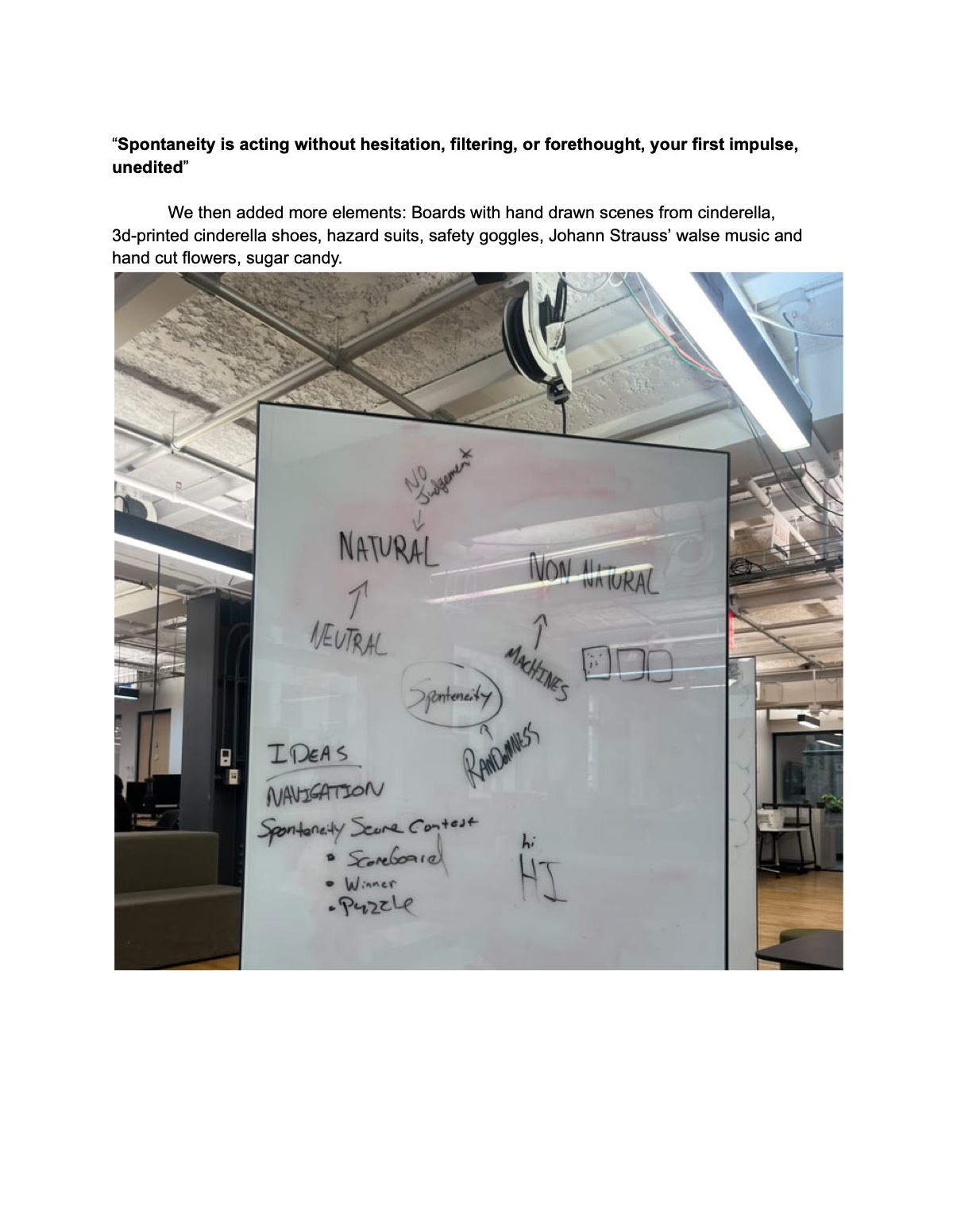
We designed a Spontaneity Scoring Contest: two rounds of games, groups, scoring and a prize to win.
Scoring spontaneity on a well defined task for a specific amount of time is a contradiction. Spontaneity is by definition unplanned. To make this contradiction even more clear, we kept developing natural and unnatural elements in the experience.
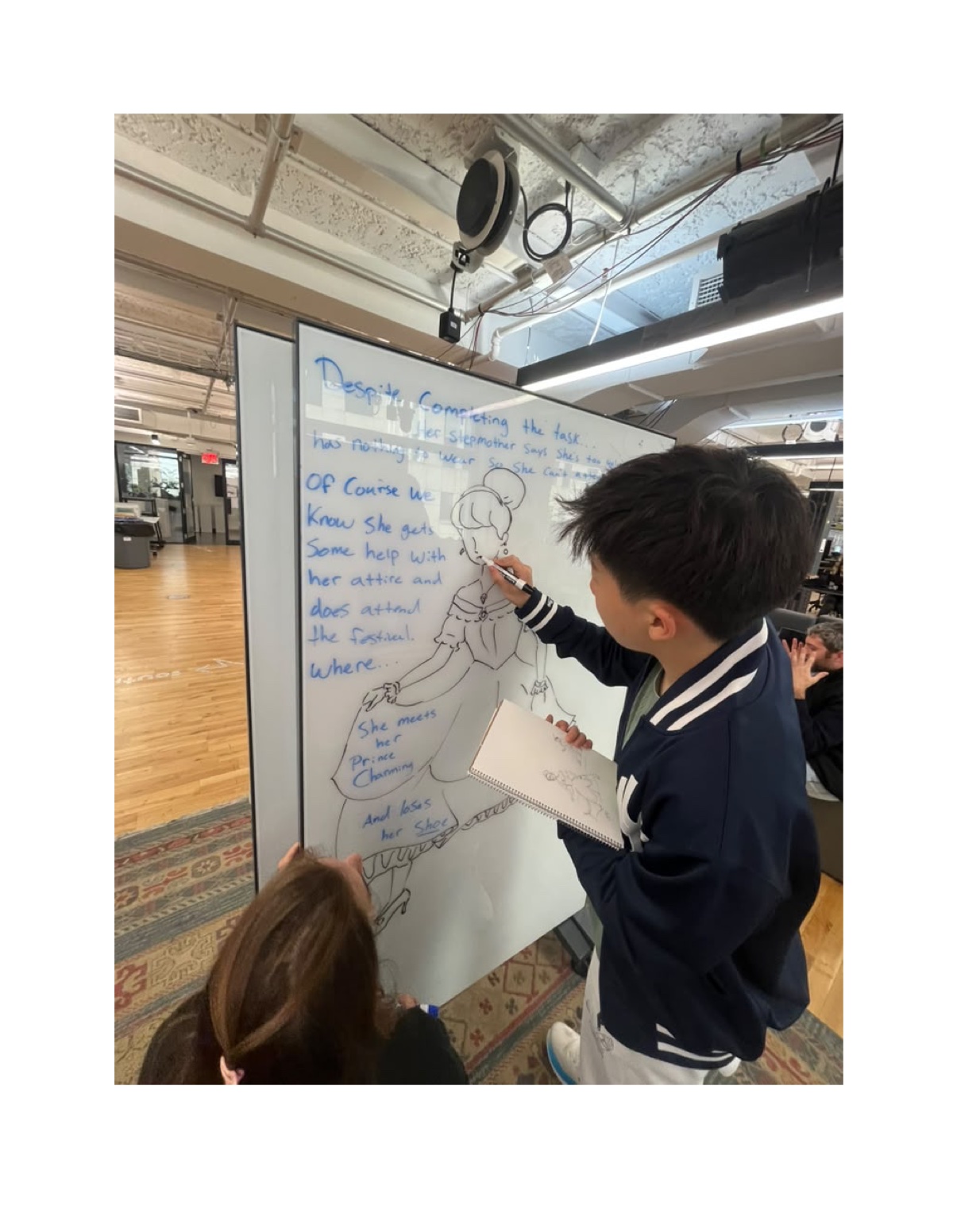
The winner receives a bouquet of flowers, there is Johann Strauß classical wales playing the lentil sorting game derived from Cinerella’s impossible task in the fairy tale. We also provided sugar and painting from the fairy tale, to foster creativity.
And yet, as a contradiction we did this in Hazmat Suits and safety goggles paired with lab vocabulary (spontaneity expert, experiment facilitator, case study, experiment).
We also believe that the Hazard suits will make for great cinematography together with the bouquet of flowers.
We developed a vocabulary for this game that mixed the tradition and beauty of the game with a research environment (case study 0 to 3, experiment 0 and 1, spontaneity expert, facilitator).
The fairytale written down by The Brothers Grimm and Johann Strauss’ waltz are responses to culture and history. We went with this story because it fit the desired game constraints and because it was mainly passed down via word of mouth (literal storytelling) in the early 1800’s. The two games allowed us to create natural action with and without constraints (freedom or lack thereof) with two environments unconstructed and very constructed. Spontaneity is a nice metric to indicate naturalness and measuring it in a defined framework is an interesting contradiction in itself. There is no nature without spontaneity (one would think) and we created conditions that kill spontaneity in its core (30 seconds to be spontaneous).
Spontaneity is an intuitive action, unplanned, without a goal, it does not comply to any structure and can not be intentional. We observed many groups acting out of the expected but still deliberate actions. Deliberate because, to score high on the defined axis (speed, authenticity, ..) and to score high in the spontaneity contest. By definition, there was no spontaneity possible in this contest. We designed this experience such that participants experience how ridiculous it is to plan anything that is intended as spontaneous.
Contraditions:
Scored spontaneity
Cut flowers
Waltz music in a sterile research laboratory, and the lab environment versus culture/history
No rules versus precise scoring framework
How to be spontaneous while given precise instructions to sort lentils
Cinderella: predictable, direct instructions, tension between following instructions and spontaneity.
First round was more comradery, it was lighter. Second round was more pressure, to perform, complete successfully.
Nature (flowers) but manipulated by humans. Nature versus machine.
Observations
We have acquired a variety of responses, solutions and performances from our activities. We can see the participants’ group efforts to come up with performances that are unexpected, ridiculous and amusing, and also actions that are rebellious against the instructions.
participants entrance, before the Intros and activities begin
Several participants felt confused and amused, by the setting (including our hazmat suit)
Experiment 1 (discuss and make a spontaneous action, 30 sec + 30 sec)
Case (group) 0 : participants show clear confusion about the scoring criteria during the discussion stage. Some felt shy to perform in front of others. What they decided to do is everyone holding hands together, moving horizontally to left and right like how crabs move, and then spinning around.
Case 1 : participants seem to have different ideas during the discussion stage. In the action, the case members scatter out into the crowd, have one person doing a count down from 5, and scream out very loud simultaneously at the end.
Case 2 : What they decided to do was having one person narrating a casual story and the other two people acting out real time (they did not know what story it was).
Case 3 : What they decided to do was having one person standing still and raise their hands, mimicking a tree, and the other two people act as a rabbit and wolf by hopping around and mimicking their sounds, performing a story of a rabbit being chased by the wolf around a tree, and the wolf finally gets the rabbit.
Experiment 2 (sort lentils, 1 min)
Case 0 : The case members started with sorting lentils as a team, but over half way through, someone changed their mind and convince the group to hand lentils to the participants who are sitting and outside of the action.
Case 1 : In the early stage, one member just splashes the lentils in the big bowl all over. Some case members expressed surprised and confusion. During the sortings, the one who splashed the lentil says its good for the surprise scoring, and another asks how Cinderella is related to the activity. The participant who splashed the lentil took one of her shoes off in the end and left it on stage (shortly), probably in response to that question. Afterwards they helped clean up the lentils back to the bowl.
Case 2 : One of the case members splash the lentils again. Then they just sort the lentil as best as they can. Afterwards they also helped clean up.
Case 3 : One member pulls the lentils out of the big bowl, they quickly gathered all lentils together without trying to sort them, and stack all four bowls up-side-down above the lentils.
Participants’ responses:
Cinderella’s impossible game of lentil sorting is a really deep experience (emmanuel)
Confused about the settings (flowers, hazard suits) and the Cinderella context - ziheng
The scoring made me think of Alan Watts’ story of the Zen master testing young Geisha to see if she had zen training.
Liked the idea of testing spontaneity and the break down into the dimensions (speed, authenticity, commitment and surprise)
Facilitator Observations:
Participants followed instructions willingly
Some wanted to ask more questions but overall they were very quiet. Not sure if this means they fully understood the assignment or just the base task
When asked to be spontaneous with no constraints (no puzzle or end goal thats obvious) most of them resorted to flashy behavior including yelling or moving around a bunch
It was very fun to be able to command a group of people and then give them creative freedom. Some parts of me wanted to encourage my definition of spontaneousness onto them when they did little or were more quiet. But I think this is because I had a preconceived notion of what I wanted them to experience
Most people seemed to be having fun
Scorer Observations:
I found scoring speed, authenticity, commitment and surprise on the spot to be difficult. I would have needed much more reflection about the performances that I witnessed to assign scores.
Some groups followed the rules of the game tightly, showing complicity to the task instruction but not to the goal to win the game
Some groups showed high creativity (counting to three and shouting, spilling all lentils, acting as rabbit, tree and wolf, rabbit chased the wolf around the tree). Even if creative, these actions were all planned and agreed and not spontaneous.
Some groups did show signs of second guessing themselves (should we add the shoe into the lentil bowl, please do, please do not). Interestingly, this was against the suggestion of the game scoring (no second guessing) and yet this was the most spontaneous moment in the experience. Two humans disagreeing on an action, without agenda, purely intuitive tension.
Reflections
Would love to do a photoshoot with hazmat suit and flowers.
Interested in keep shaping this experience more precisely and trying out different natural and unnatural elements together.
It is hard to design a content full experience that is pleasant to participants if there is not a lot of time.
Being able to have a survey after would be great to get feedback on what went well vs what didn’t, who felt uncomfortable, who enjoyed it, etc.